


Posted on October 10, 2013, by Goran Čandrlić | 8 minute read
In comparison to the year 2012, the growth of IT spending for the current year has dramatically decreased. It's growing by mere 6% on the smartphones and tablets market, decreasing by 0,2% for hardware, with an overall growth percent rate of 1,8%. The only improvement is visible on the software and industry-specific software market. "Software is holding its own with cross-industry (SaaS territory) and industry-specific software continuing to be the spending bright spot. We see public cloud Infrastructure as a Service (IaaS) growing at 15 percent and Software as a Service (SaaS) growing at 17 percent in 2013. On-premise and public clouds (and hybrids) are driving systems and management software growth," according to GigaOM. However, we are still talking billion dollar industry, no matter how deep on the bottom it bumps. See the table below for an overlook of the 2012 and 2013 worlwide IT spending (in USD billions).
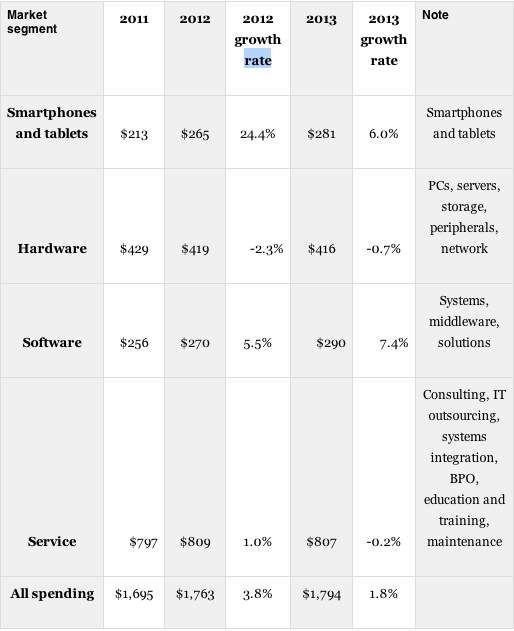
Image 1 - 2012 and 2013 worlwide IT spending (in USD billions)
Image source: http://pro.gigaom.com/report/third-quarter-it-spending-analysis-and-outlook/
Read more, or download the full report.
Continuing on the topic, more predictions for IT organizations and IT users are available from Gartner, for 2014, more focused on future disruptive technologies. The impact of digital industrial revolution, digital business, smart machines, as well as the internet of things is looked into in this report. The findings were originally presented at the Gartner Symposium and are as follows:
Read more from CloudTweaks.
What the new world of cloud IT means for the network? This is the topic of a new Forrester consulting study. From the executive summary: "By leveraging innovative cloud services in their approaches to IT, enterprises can take advantage of new resources that maximize economies of scale and agility — investments that can give them a distinct advantage over competitors that come to web services from a traditional IT foundation. In this environment, infrastructure and operations (I&O) teams will realize how different cloud environments are from traditional IT infrastructures. Even though individual cloud infrastructures are standardized, each cloud service — such as backup-as-a-service, infrastructure-as-a-service,
software-as-a-service, business-process-as-a-service, and platform-as-a-service — provides customers with a unique and widely varied set of services." Their findings show that a majority of businesses have embraced at least one cloud service, that application developers and business stakeholders are pushing IT decision-makers to create a hybrid cloud infrastructure so that business organizations within the enterprise can take advantage of the most-efficient set of IT resources, an finally that the value of cloud services can only be attained when network initiatives align with cloud strategy and migrations. What it means to the network?
links on the LAN, these connections will have to meet business-level performance requirements
The full report can be downloaded here.
Remember Amazon? The largest gathering of developers and technical leaders from the AWS community is scheduled for next month, November 12-15. In Las Vegas, and it's expected to be - huge.
YouTube: AWS Re:Invent 2013 Trailer
175+ sessions, ranging from introductory to deeply technical will take place at the event. An interesting point about AWS industry, comes from David Linthicum, an expert in cloud technology, that will hopefully be looked into at the event, and those are the three barriers between Amazon Web Services (AWS) and businesses. "Although AWS has done well with companies with less than $1 billion in revenue, larger enterprises are still slow on the uptake when it comes to AWS," Linthicum explains, i.e. "enterprises always want a deal". Secondly, "AWS does not budge on its SLAs." Finally, "AWS does not appear to take utility-based computing mindsets into account."
Read more from Linthicum.
The official AWS Re:Invent webpage
News from The Verge. Eric Schmidt will reveal stories and advice from how he led Google for a decade in an upcoming book "No Adult Supervision Required: How To Build Successful 21st Century Companies" just upon releasing his former one, "The New Digital Age." Indeed, a hot question among all business-minded individuals. The management manual will be co-written with Jonathan Rosenberg, one of Schmidt's top lieutenants at Google. The book is scheduled for the fall of 2014. Until then, good luck with managing your business on your own.
Read more from The Verge.