Posted on May 16, 2013, by Goran Čandrlić | 4 minute read
"In 2004 it was about using RSS feeds to read blogs. Today, Google Glass is like a reader, pulling in data to a lens that transmits it for the human mind to read. Again, it’s a new way to turn data into services," reports Alex Williams for Tech Crunch and looks back on Google I/O conference, an annual developer-focused conference held by Google in San Francisco, California.
Williams, among others, talked to Robert Scoble, from Rackspace, wearing a Google Glass for that occasion.
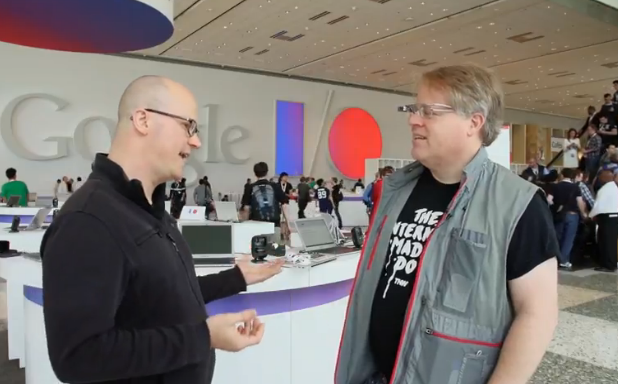
Alex Williams (Tech Crunch) and Robert Scoble (Rackspace) at Google I/O
Robert Scoble talks about future contextual OS, the new contextual APIs, about Google being on the top of the world, but missing to show new mind blowing stuff at the conference?
See the full video and read the report here.
Adobe and SAP stepped to the cloud, started using the cloud computing technology, and we are to see more such mega corporations embracing the cloud in the future, says Dan Morril for Cloud Ave. "In the case of SAP, their software is complex, and beyond the knowledge of many people to simply use," Morril explains, and continues with why moving to the cloud makes most sense for these companies:
Read the full article by Dan Morril here.
Robert Jenkins, CEO of CloudSigma, poses this question for the ReadWrite: "Why hasn't technology helped speed up movie production, appeasing fan excitement and helping Hollywood powerhouses maximize revenue streams?" He believes that "the answer may lie in the cloud." Sluggish schedules in the movie industry, and he uses the example of Hunger Games, could be helped by technology. Many people need to collaborate on making a movie, and this often turns out inefficient and costly. Also, continuous innovations in the movie industry, such as higher frame rates, 3D, streaming video, CGI, as Jenkins describes them, "have unleashed an unprecedented influx of data. Media service providers," Jenkins believes, "must spend more time and resources developing, transferring, storing and optimizing" this data. A chance for this kind of elasticity lies in adopting a cloud computing technology. This helps with collaboration from all over the world, and using the technology if and when needed. "After all, who wants to wait until November 2013 to see part two of The Hunger Games trilogy?," he concludes.
Read the full article here.
David Linthicum's weekly podcast series continue. Powered by Cloud Technology Partners and hosted by Tech Target, David Linthicum brings various cloud computing experts and discusses hot "cloud" issues on a weekly basis. You can download here the episode IV, titled "To PaaS, or Not to PaaS?" concerning Platform as a Service model, made on May 14th, 2013.
"Convergence," was their word of the day for the cloud, other topics tackled private cloud & PaaS, especially OpenShift, the Red Hat's free, auto-scaling Platform as a Service (PaaS) for applications. What Platform as a Service does? What are the strengths and weaknesses of this approach? What is the gap?
Download the full episode (28 minutes) here.
Robert Smith writes for CloudTweaks: "In 2012, cloud computing became a much bigger trend in the business and networking world. IDC have predicted a 130% increase in cloud computing by 2016, meaning an increase to $43 billion." He explains the ongoing trends for cloud computing in 2013, and puts them down to five most important directions:
Read the full article here.