Posted on March 29, 2013, by Goran Čandrlić | 3 minute read
The leading telecommunications company in the Republic of Korea, KT, announced on March 26th that it will expand partnership with Akamai, the leading cloud service provider, headquartered in Cambridge, Massachusetts.
"KT has agreed to leverage technology from Akamai to provide CDN services to its customers in Korea. Using Akamai's Aura Managed CDN, KT will have dedicated CDN capacity that is available for its own content applications or third party CDN services," it is stated in the official press release. "Under the new expanded partnership, KT will be equipped to address the explosion of online multimedia traffic resulting from a range of connected devices, changing viewer habits, and social networking."
At the core of Akamai's solutions is the Akamai Intelligent Platform that KT aims to leverage in order to deploy and sell their own operator CDN. Heekyung Song, Senior Vice President at KT, said: "The era has come where culture and digital content are leading the market. Our main priority is to ensure access to content from any device, at anytime, anywhere."
Read the full press release from Akamai
CIA has reached a cloud computing agreement with Amazon, in a contract worth $600 million over 10 years, although, as a general rule, the details of the contract are not publicly disclosed. CIA aims to build a private cloud infrastructure with the help of Amazon, to keep up with big data and emerging cloud computing technologies, in a cost-effective manner. The cloud would run on the government's iron behind a firewall.
The problem with this sort of approach from a public cloud provider such as Amazon, once it decides on building a - private cloud, "is that it moves their business from services to software", comments David Linthicum. "Their technology is not designed as software, so a great deal of effort will be needed to make that change work."
Find more comments on the CIA-Amazon deal from Linthicum here and read the FCW article.
OpenDNS, that secures the networks used by more than 50 million people to connect to the Internet, has released an infographic that nicely depicts the state, nature and flow of big data, i.e. the exponential growth, availability and use of information. It is crucial that the companies engage in providing security for the ever growing amounts of data in the computer world.

NetApp, an American multinational computer storage and data management company based in Sunnyvale, California, has released an infographic on big data, as well, but as if it were located in human body, and was about human body. The data graphed is data used by healthcare analytics and it includes the cloud computing technologies which are on the rise in the healthcare industry. It is estimated that by 2015, the average hospital will generate 665 terabytes of data. Today, 80% of healthcare data, such as images, video and e-mail, remains unstructured.
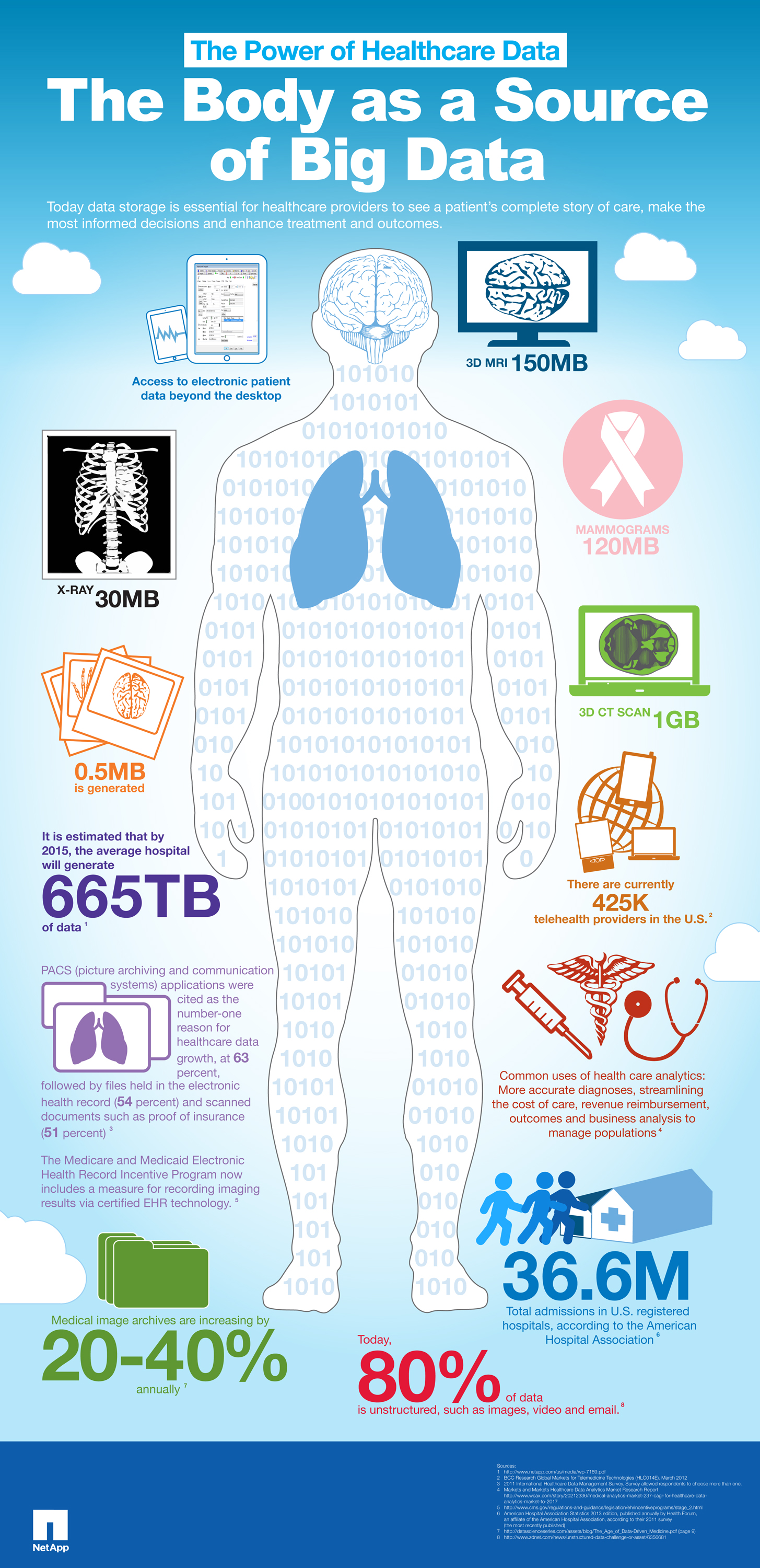
Infographic source: NetApp
Hybrid cloud, defining the cloud location, means, using both private (expensive, private infrastructure) and public clouds (such as Amazon, Salesforce, Google Apps), depending on their purpose. "In the context of data backup, a combination of private and public backup solutions can be used to form an efficient and robust platform," says new white paper published by Datto Inc, an award-winning vendor of backup, disaster recovery (BDR) and intelligent business continuity (IBC) solutions. The hybrid cloud backup system is described in detail in terms of ensuring business continuity, as well as other backup solutions and cost benefits of hybrid cloud.
The paper can be downloaded here, by providing some company info.