Posted on March 22, 2013, by Goran Čandrlić | 4 minute read
As more and more companies are turning to cloud computing, they need to hire more stuff with cloud computing skills. Which are, half of the time, difficult to find, according to the survey that Rackspace conducted while researching the potential market market for the Cloud Academy: "Rackspace surveyed 1,300 businesses in the U.S. and England and found that 42% of companies are hiring workers with cloud computing skills, but 43% said they are finding it difficult to find IT professionals with the cloud computing skills."
Rackspace training program will teach skills in various open source areas, such as OpenStack, Hadoop and Linux, with a specific focus on - cloud computing. The pilot Academy was launched on March, 19th. The cost of online programs is $200, plus a $20 per month fee, in a sort of education-as-a-service model. "Academic institutions just haven't caught up yet to the cutting-edge skills needed by companies like Rackspace today," says Graham Weston, the founder and chairman of Rackspace.
Find out more from Network World
All types of cloud services are now widely used by companies; Infrastructure-as-a-Service (IaaS), Platform-as-a-Service (PaaS), Software-as-a-service (SaaS), and more. Jack McCarthy offers a list of what he considers to be top 100 vendors of such services, he selects top 20 from five different groups:
The vendors are presented in groups and on separate slides. "Salesforce.com may have started the Software-as-a-Service revolution, but others quickly followed," claims McCarthy. "Microsoft, Google, and other established vendors provide their signature software apps through the cloud. Many other newer firms are offering vertical solutions, such as financial reporting as well as testing, app development and more."
Check out the charts above and read the full article by McCarthy here.
We have discussed a lot the importance of a millisecond advantage in a page loading speed. And how about a minute, what can happen in an internet minute? In terms of views, users, queries, even infections. Intel prepared an interesting infographic.
"By 2015, Intel estimates, the number of Internet connections will double that of the world's population," the scale of which, as commented at ReadWrite, is still hard to put together.
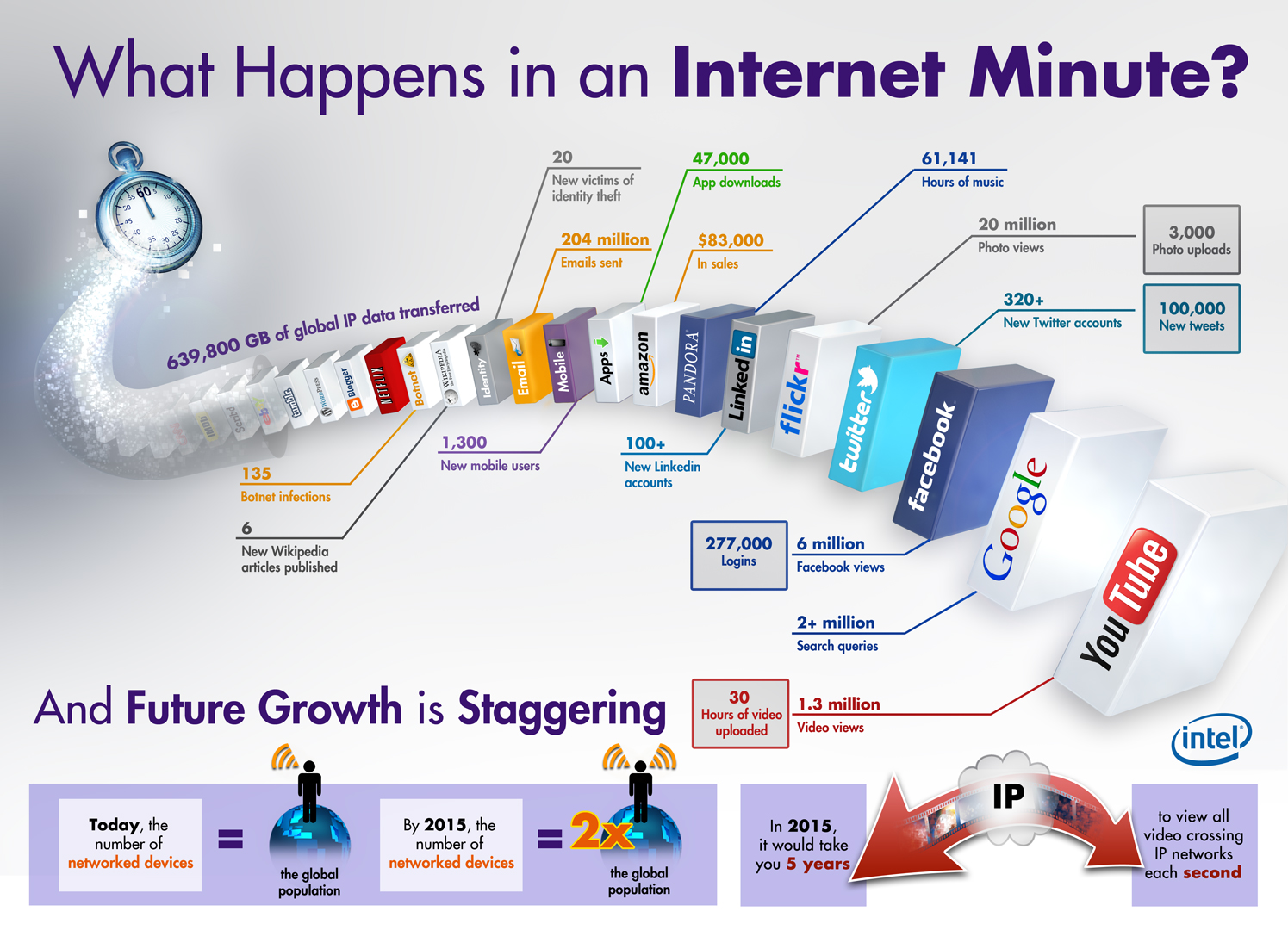
Check out the infographic above and find the full article by ReadWrite here.
Another vision from the future, Bahnhof is looking to build a data center in Stockholm, which will be in a gas-plant, and with a theater on top.
A data center houses servers, storage and network devices which are here located, operated and managed. Jon Karlung, Bahnhof CEO, wants a theater to sit on top of one such data center: “I think it’s an elegant mix: culture and technology and business."
Robert McMillan comments for The Wired: "But, first, Bahnhof has to fill up the five stories of space that will get him to the building’s dome, which tops out at about 130 feet. For that, the company is using a modular data center design that lets them quickly add new floors, much in the way you’d slap together an Ikea shelving set."
YouTube Video:
Check out the video about the Bahnhof Modular Data Center design planned for spring, and then, read the full article about the theater data center from the Wired magazine here.
As from July 1st, Google Reader service will be shut down, due to another "spring cleaning", according to Google.
From 2011, this will add up to a total closure of 70 such services, by the firm.
Dave Michels, for CloudAve, tries to rethink if this is a cloud dissipation problem, whether he should be thankful for what the cloud service has offered so far, or be lost without it, or seek alternatives. "When you rely on a cloud provider, you are at greater risk than relying on a product," he comments.
More than 500,000 Google Reader users will now migrate to Feedly, according to Mashable.