


Posted on March 15, 2013, by Goran Čandrlić | 4 minute read
Pingdom conducted a research to check in which cities the most of the world's content is hosted. They have listed 7,936 cities that between them host the top one million sites in the world. The results are plotted on an interactive map. Also, they provide a list of the top 100 web hosting cities. The top 10 cities combined, account for 223,206 sites or over 22% of the world's content (check the list below). The top 3 cities combined account for about 10% of the top million websites. The city with the biggest number of these top websites is Houston, Texas, followed by Mountain View, California and Dallas, Texas. The US thus has the lead in terms of hosting locations. The data was collected February 27, 2013 with a Pingdom developed script that scanned the Alexa top one million sites.

Find the full list and explore the map here
Reuven Cohen, a contributor to Forbes, takes on a recent report made by international market research and advisory company IDC, which expects increase of cloud delivery in Saudi Arabia, for example, by 34%. With annual growth rate of 49.7 percent between 2012 and 2016. He also mentions partnering between cloud companies and large telecom operator in the Middle East, as well as investments of data storage and network specialists (such as Cisco, EMC and so on) in the Middle East region cloud market. "Even with signifcant foreign investment in the market, cloud computing in the Middle East is still in its early stages," he explains.
Read the full story from Forbes as well as the story from Saudi Gazette
Majority of companies are already recognizing cost savings and increased profits when moving their organization to the cloud. The CIO piece, that refers to Rackspace survey recently conducted on 1,300 companies in the UK and US, explains that "88% of cloud users pointed to cost savings and 56% of respondents agreed that cloud services have helped them boost profits." Additionally, they continue, "60% of respondents said cloud computing has reduced the need for their IT team to maintain infrastructure, giving them more time to focus on strategy and innovation." Reducing IT costs, however, is only one of the benefits, says CIO, of moving your strategy to the cloud. Top five benefits are, according to the Rackspace study:
Read the full news from CIO
A new cloud platform has been recently created that is to serve as a central processing and data-access brains for robots located throughout the world. "Essentially, they’re treating robots like any other device — desktop, tablet or mobile phone — running web applications, only robots can learn from each other and can do a lot more than just update screen displays," writes GigaOM. The project is known as RoboEarth, or Rapyuta, The RoboEarth Cloud Engine. It implements a Platform-as-a-Service (PaaS) framework designed specifically for robotics applications. "Robots can start their own computational environment, launch any computational node uploaded by the developer, and communicate with the launched nodes using the WebSockets protocol," as explained on the official RoboEarth page. The name Rapyuta is taken from the movie Tenku no Shiro Rapyuta (English title: Castle in the Sky) by Hayao Miyazaki, where Rapyuta is the castle in the sky inhabited by robots.
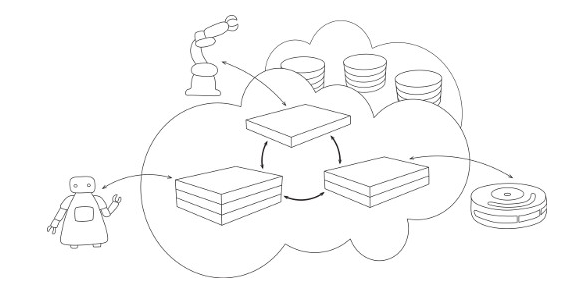
Visit the official RoboEarth page
Jason Perlow, technology editor at ZDNet, chooses to disassemble the top 4 grievances of those who are still skeptical of the cloud, and claims: "You will be assimilated." What he picks on are the following concerns:
Perlow gives an all-embracing explanation of each, and elaborates on theories that he considers to be more closer to the truth. "You'll have more individual computing power from moving to the cloud… The reality is that software as a service and subscriber software services are actually less costly to both the end user and the enterprise in the long run…"