Posted on February 22, 2013, by Goran Čandrlić | 4 minute read
Nasuni group, an enterprise storage company, has published their 2013 State of Cloud Storage report, a white paper downloadable at request, and an infographic that describes the current pace of growth of the cloud technology as well as the current state of cloud storage. It is estimated that there is over 1 Exabyte of data stored in the cloud at the moment. What does it mean in real life, what it would take to count it, how this data can be read/written in the cloud, who are the top performers, find out for yourself from the infographic attached below.
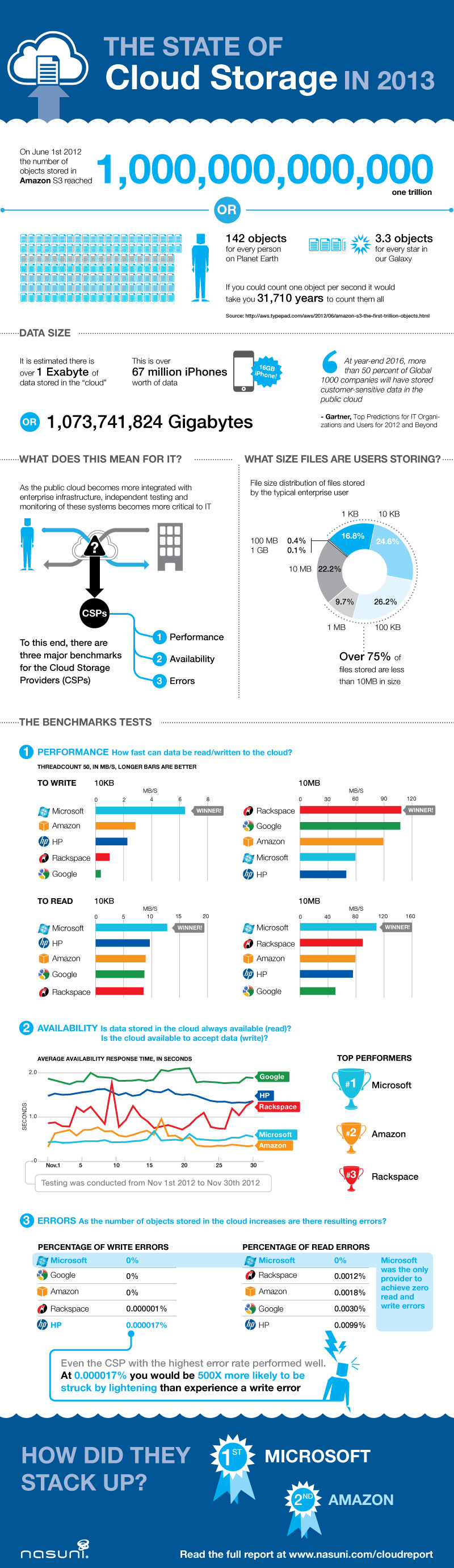
Image source: Nasuni
Payment Card Industry (PCI) trade group has released guidelines for cloud security. In it, they advise those in the business of electronic payment transactions on how to use cloud computing technology more efficiently. Also, how to maintain standard controls within the cloud environment. "Cloud security is a shared responsibility between the cloud service provider (CSP) and its clients. If payment card data is stored, processed or transmitted in a cloud environment, PCI DSS will apply to that environment, and will typically involve validation of both the CSP’s infrastructure and the client’s usage of that environment," the summary states. Further on, the document provides detailed guidance on the usage of cloud technologies and considerations for maintaining PCI DSS controls in cloud environments. The document is intended for merchants, service providers, assessors and other entities looking for guidance on the use of cloud computing in the context of PCI DSS, according to the guidelines introduction.
Read more from InfoWorld
Download the PDF guidelines here
Amazon Redshift, a fast, fully managed, petabyte-scale data warehouse service that makes it possible to simply and efficiently analyze all your data using your existing business intelligence tools, now became widely available. Amazon announced mixing in the analytics of the third party data, including including SAP, Cognizant, IBM, Informatica, Tableau, Attunity, Actuate, Pentaho, Talend, Birst, Roambi and Pervasive. “With order of magnitude improvements in price/performance, Amazon Redshift makes big data analytics accessible to more people, allowing large organizations to analyze more of their data and smaller ones to afford fast, scalable data warehousing technology,” said Raju Gulabani, VP of database services at AWS (Amazon Web Services). AWS announced that its Redshift data warehouse service can now be used by companies in social media, gaming, mobile, advertising, manufacturing, health care, e-commerce and financial services.
Read more from TechCrunch
"The cloud computing market in the health care sector is expected to grow to $5.4 billion by 2017," according to Markets and Markets research. "Doctor’s clinics, hospitals, and health clinics require quick access to computing and large storage facilities which are not provided in the traditional settings, moreover healthcare data needs to be shared across various settings and geographies which further burdens the healthcare provider and the patient causing significant delay in treatment and loss of time," it is said in the report description. Moreover, due to their limited budgets, the health care industries are taking this step into the "cloud", in order to reduce operational costs. The security issues of the patient data, and the required IT knowledge to move the system safely to cloud-based platforms, are still to be discussed. But the transition is inevitable, and the need to be able to centrally manage patient data that now only exists in silos. Not to mention that physicians and clinicians will be more adept in their decision making from the aggregated data, with the cloud adoption, and thus benefit more from it than other sectors.
Read more from Cloud Computing Journal
Cloud computing technology generally reduces power consumption by decreasing hardware requirements, by reducing the reliance on natural resources, such as paper, by limiting resource redundancy, and so on. Microsoft reports and studies prior to the 2013 have found that the cloud cuts the carbon footprint of the least efficient businesses by up to 90%. Another recent study by Salesforce proved that their customers emit 95% less carbon than companies that run their systems in on-premise application servers. The only disagreement rises from the National Data Center Energy Efficiency Information Program research report from 2006, that says that Data Centers used 61 billion kWh of electricity, equivalent to 1.5% of all U.S. energy consumption.
Find out more, and decide which is true, from Greener Ideas