Posted on April 5, 2013, by Goran Čandrlić | 4 minute read
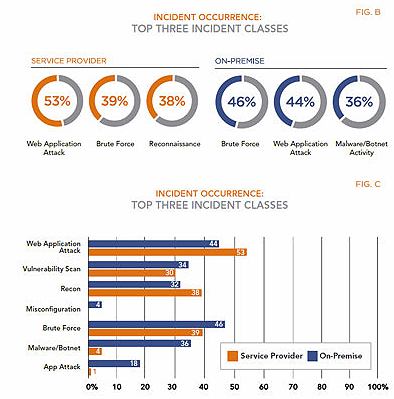
At GigaOm, David Linthicum discusses the security issues with enterprises, compared to public cloud computing, i.e., which is better, security within the public clouds or security within traditional enterprise systems. "According to Alert Logic’s Fall 2012 State of the Cloud Security report, the variations in the threat activity are not as important as where the infrastructure is located. The report finds that anything that can be possibly accessed from outside, whether enterprise or cloud, has equal chances of being attacked because attacks are opportunistic in nature," Linthicum explains. While this is a complex issue, it seems that, in some instances, cloud computing actually provides better security, Linthicum draws from the Alert Logic report (see image below).
Read the full article from GigaOm.
Find the Alert Logic report here.
John Omwamba writes for CloudTweaks: "Now there is a better chance to make use of the learning systems to tap into the fourteen million employment opportunities that the cloud will deliver in three years’ time." He brings examples of giants such as Microsoft and IBM that have both already developed technologies to leverage learning the modern way, and about - cloud. "Such technologies bring resources closer to the desktop so that learners can enter into the employment sector with computing skills that matter to the contemporary world," Omwamba continues. Also, jobs in cloud sectors are expanding, and organizations now need to hire CIOs, vending personnel, infrastructure builders and so on. "The secret to all these jobs is that they need educated minds who understand the practical rather than the hyped side of the cloud."
Find the full article on CloudTweaks.
The date of the OpenStack Summit in Portland, Oregon, is approaching, April 15-18. The Summit is actually a four-day conference for developers, users, and administrators of OpenStack Cloud Software. "HP's strong presence at the show will come at a critical time. Like IBM, Dell and other rivals, HP is building its public cloud atop OpenStack, the open source cloud platform," Panettiery reports for Talkin' Cloud.
Expected attendees will include:
The OpenStack Summit is said to focus heavily on ISVs (independent software vendors) and corporate adopters.
Find the full article here.
Find more info on the OpenStack Summit.
"When a European company signs up to a cloud service, although the cloud vendor is handling the company's data, it is the company that retains responsibility for how the cloud vendor does so," writes The Guardian in consideration of the cloud computing and EU law.
There are tight controls on processing personal data, whether this involves regular or cloud vendors. "European law requires appropriate technical and organisational measures to be taken against unauthorised or unlawful processing of personal data and against accidental loss destruction of, or damage to, such data," it continues. Thus, the article proposes some issues for the companies to regard before putting personal data on the cloud, such as:
Find the full article from The Guardian.
Internap brings a piece on how including a Content Delivery Network (CDN) makes it possible for the cloud to meet the performance expectations of end users. Also, to increase the competitive advantage of a company. They list six obstacles that CDNs successfully address:
"Using CDN and cloud together," they say at Internap, "can address these challenges and create the right IT Infrastructure for an optimal online user experience."